Top 5 DJI drones by flight times (2026)
Every extra minute flying means more shots, more coverage, and fewer battery swaps. We rank the top 5 DJI drones by flight times — then by value, using cost per flight minute — so you can find the longest-flying drone that fits your budget.
Quick answer
Among DJI’s current consumer drones, the Mavic 4 Pro leads with up to 51 minutes of flight time, followed by the Air 3S (~45 min) and Mini 4 Pro with its Intelligent Flight Battery Plus (~45 min). For pure value, the Mini series wins — the Mini 4 Pro and Mini 3 deliver the lowest cost per flight minute of any DJI drone.
WHAT’S IN THIS GUIDE
- How we ranked them
- Top 5 DJI drones by flight time
- Best Value: cost per flight minute
- Full comparison table
- How to maximize your flight time
- Choosing the right drone
- FAQs
How we ranked them
Flight time is the headline number, but it isn’t the whole story. We focused on DJI’s current consumer and prosumer lineup (the drones most pilots actually buy), used manufacturer-rated flight times under ideal conditions, and then layered in a value metric — cost per flight minute — so a $469 drone isn’t unfairly compared to a $12,000 enterprise platform.
About the numbers
Flight times are DJI’s published maximums in calm conditions. Real-world flight time is typically 15–20% shorter once you account for wind, maneuvering, and landing with a safe battery reserve. Prices change often — confirm current pricing before buying.
Longest flight time overall
If raw endurance is all that matters, DJI’s enterprise platforms win — but at $10,000+, they’re built for industrial inspection and public safety, not the average pilot. Here are the absolute flight-time leaders:
DJI’s new endurance king: up to 59 minutes of forward flight and 53 minutes hovering — even carrying a payload. Roughly 50% more effective flight time than the M350 RTK it replaces.
The previous enterprise champion and still a capable industrial platform, now succeeded by the Matrice 400 but widely deployed for mapping and inspection.
Be honest about who these are for
The Matrice line is incredible, but it’s overkill (and out of budget) for 99% of pilots. If you’re shopping for a drone to actually buy and fly, skip to the consumer cut below.
Longest consumer drone you’d acutally buy
This is the list most readers want: the longest-flying DJI drones a hobbyist or working creator would realistically purchase. Two models tie for the consumer crown at 51 minutes.
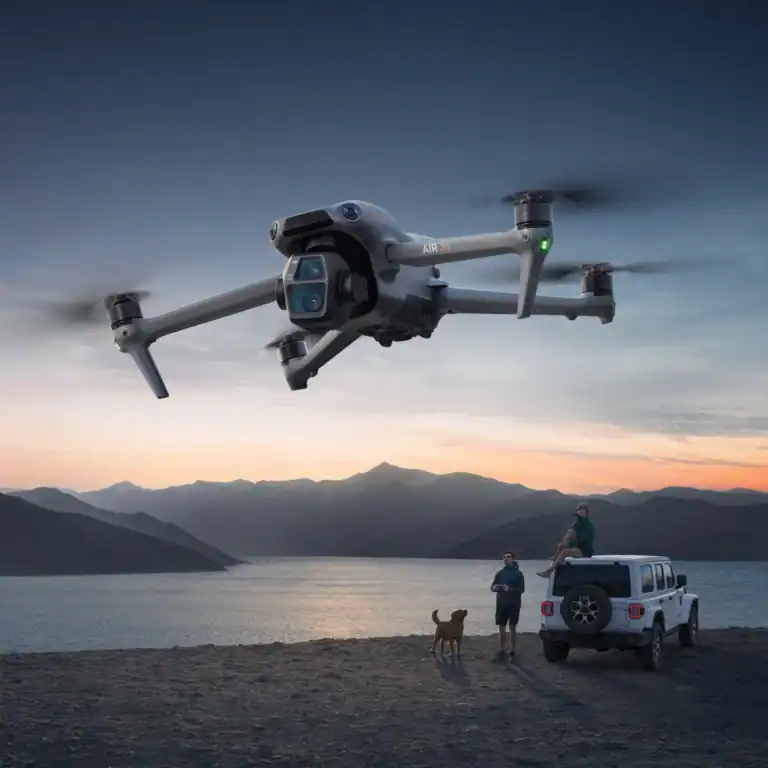
The benchmark long-range consumer drone of 2026: 51 minutes of flight time paired with a triple-camera Hasselblad system. The pick if you want maximum endurance and pro-grade imaging.
The value champion. With the Intelligent Flight Battery Plus it matches the flagship’s 51 minutes at a fraction of the price — though that battery pushes it over 250g (see the catch below). On the standard battery it’s about 38 minutes.
A step up from the Mini 3 with a larger sensor, faster aperture, and tri-directional obstacle sensing — still hitting 47 minutes with the Plus battery.
The sweet spot for serious hobbyists — dual cameras, all-around obstacle sensing, and long endurance at roughly half the flagship’s price. No Plus battery needed to hit these numbers.
The latest standard Mini, with omnidirectional obstacle sensing and true vertical shooting. Up to 45 minutes with the Plus battery, ~34 minutes on the standard pack.
* Extended flight time requires the Intelligent Flight Battery Plus — which pushes these sub-250g models over 250g and into FAA registration territory. More on that below.

Best value: cost per flight minute
Dividing the price by flight time reveals which drones give you the most air time for your money. By this measure, DJI’s Mini lineup dominates — you pay the least per minute aloft, which is why these models remain the smart buy for enthusiasts and budget-conscious pros.
The takeaway
If you want the most minutes per dollar, buy a Mini. If you want the most absolute flight time with pro imaging, the Mavic 4 Pro is the consumer pick. The Air 3/3S is the best all-around compromise — and gets there without a Plus battery.
The 250g battery catch
Here’s the detail most listicles skip: those headline flight times for the Mini series only happen with the Intelligent Flight Battery Plus — and that bigger battery pushes the drone over 250 grams.
That matters because the sub-250g weight class is exactly what lets recreational flyers skip FAA registration. The moment you fit a Plus battery to reach 45 or 51 minutes, your Mini is no longer under 250g, and you must register it with the FAA for recreational use.
So you have a chocie to make with every mini
Standard battery — stays under 250g, no registration, but shorter flight time (~38 min on the Mini 3). Battery Plus — longer flight time, but you cross 250g, and registration is required. See how to register your drone →
Full table comparison
Current DJI drones ranked by flight time, with value (cost per flight minute) for context:
| Model | Category | Flight time | Price (from) | $/min |
|---|---|---|---|---|
| Matrice 400 | Enterprise | 59 min | ~$10K–20K | — |
| Matrice 350 RTK | Enterprise | 55 min | ~$12,000 | $218.18 |
| Mavic 4 Pro | Flagship | 51 min | $2,199 | $43.12 |
| Mini 3 (Battery Plus) | Mini · sub-250g† | 51 min | ~$469 | $9.20 |
| Mini 3 Pro (Battery Plus) | Mini · sub-250g† | 47 min | ~$759 | $16.15 |
| Air 3 | Prosumer | 46 min | ~$1,099 | $23.89 |
| Air 3S | Prosumer | 45 min | ~$1,099 | $24.42 |
| Mini 4 Pro (Battery Plus) | Mini · sub-250g† | 45 min | ~$759 | $16.87 |
| Mavic 3 series | Professional | 46 min | ~$1,599 | $34.76 |
| Mini 3 (standard battery) | Mini · sub-250g | 38 min | ~$469 | $12.34 |
| Mini 4 Pro (standard) | Mini · sub-250g | 34 min | ~$759 | $22.32 |
| Avata 2 | FPV | 23 min | $999 | $43.43 |
| Neo | Micro | 18 min | $199 | $11.06 |
† Stays under 250g only on the standard battery; the Battery Plus that delivers these flight times pushes it over 250g and into FAA registration. Prices and flight times are DJI’s published figures and change often — verify current specs and pricing at DJI’s store before purchase.
How to maximize your flight time
No matter which drone you fly, these habits squeeze out every available minute — and protect your battery’s long-term health:
- Store at storage charge. Leaving batteries fully charged or fully drained for long periods degrades them. Most DJI batteries auto-discharge to a storage level
- Fly in calm conditions. Wind is the single biggest drain — fighting gusts can dramatically cut flight time. Check the weather and airspace first.
- Keep batteries warm. Cold weather reduces capacity. Store batteries near room temperature and warm them before flying in winter.
- Update firmware. DJI regularly tunes power management — staying current can improve efficiency.
- Fly smoothly. Aggressive acceleration and constant altitude changes burn power faster than steady, planned movement.
- Land with a reserve. Never run a battery to zero. Landing at 15–20% protects battery longevity and gives you a safety margin.
Choosing the right drone for you
Flight time is one factor among several. Before you buy, weigh:
- Registration & weight. Sub-250g drones skip FAA registration for recreational use — a real convenience. See registration rules.
- Camera quality. If imaging is the goal, the Mavic and Air lines lead; Minis are impressive for their size but use smaller sensors.
- Portability. Minis fold to pocket size; flagships need a bag.
- Budget. Buy the best value for your use — most hobbyists are thrilled with a Mini.
Remember: flight time doesn’t change the rules
A longer-flying drone still has to follow the same FAA rules. Whatever you fly, register it if required, pass the TRUST test, and check the airspace before every flight.
Got your drone? Plan a legal flight.
AutoPylot checks airspace and weather, runs your checklist, and files LAANC — free for recreational pilots.
Frequently asked questions
The longest-flying DJI drone overall is the enterprise Matrice 400 at up to 59 minutes (released 2025), ahead of the Matrice 350 RTK’s 55 minutes. Among consumer drones you’d actually buy, the Mavic 4 Pro and the Mini 3 (with the Intelligent Flight Battery Plus) tie at around 51 minutes.
The DJI Mini series offers the lowest cost per flight minute. The Mini 3 with a Battery Plus delivers roughly $9 per minute of flight — the best value of any DJI drone — making it ideal for hobbyists who want maximum airtime on a budget.
DJI’s figures are measured in ideal, windless conditions, flying at a steady speed with no payload. In practice, wind, maneuvering, camera use, and landing with a safe battery reserve typically reduce real-world flight time by 15–20%.
Maybe, but not because of flight time itself — registration depends on weight. However, the extended “Plus” batteries that boost a Mini’s flight time can push it over the 250g threshold, which would require FAA registration for recreational flying. Check the configured weight.
Fly in calm, mild weather; keep batteries warm in winter; update firmware; fly smoothly rather than aggressively; land with a 15–20% reserve; and store batteries at their storage charge level rather than full or empty.